Fun BBQ Dad Graphic - Smoked Meat Lover: Integrating High-Quality Assets into Merchandise Workflows
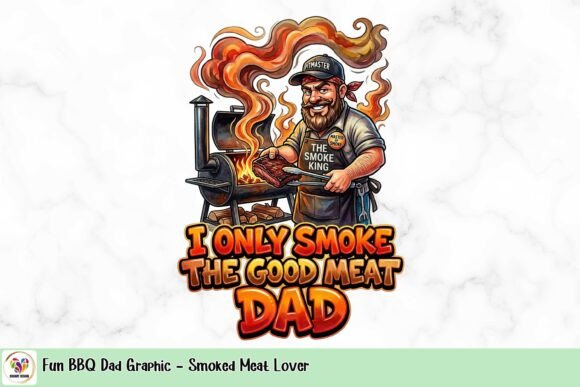
In the competitive landscape of print-on-demand merchandise and personalized gifting, the quality of source assets dictates the final product's success. The Fun BBQ Dad Graphic - Smoked Meat Lover serves as a specialized digital asset designed to streamline the creation of barbecue-themed apparel and accessories. For creators, small business owners, and hobbyists, this PNG illustration is not merely a decorative element; it is a functional component within a broader production workflow. Understanding how to leverage this specific design—featuring a bearded pitmaster in a hat and apron reading "The Smoke King"—requires a practical approach to file management, software compatibility, and product application.
This graphic fills a specific niche in the seasonal and evergreen merchandise market. It targets a demographic that values humor and identity, specifically fathers who take pride in smoking meat. By incorporating this asset into your design library, you reduce the time spent on custom illustration while maintaining a professional aesthetic. The vibrant cartoon style and bold gradient text provide a ready-made focal point that interacts predictably with various garment colors and printing techniques. Successful integration depends on treating the graphic as a modular element that can be adapted across different stages of the creative and commercial process.
Pre-Production Assessment and Asset Preparation
Before importing the Fun BBQ Dad Graphic - Smoked Meat Lover into any design software, a technical assessment ensures efficiency downstream. Although the file is provided in high-quality PNG format, verifying resolution relative to your intended print area is a critical first step. For standard t-shirt printing, the design should maintain at least 300 DPI at the final print size. If you plan to scale the image for larger items like hoodies or tumblers, check the pixel dimensions to prevent interpolation artifacts that degrade print quality.
Color profiling is another essential preparation task. Screen displays use RGB color space, while direct-to-garment (DTG) and sublimation printers typically operate in CMYK. This graphic features prominent gradient letters and vibrant cartoon colors that may shift during conversion. Create a test swatch or soft proof in your editing software to anticipate color changes. Because the design includes bold text stating "I only smoke the good meat Dad," legibility must remain intact after color space conversion. Adjusting contrast or saturation prior to printing ensures the message remains clear and the visual hierarchy stays balanced.
File organization often gets overlooked in creative workflows. Rename the asset with descriptive metadata including keywords, dimensions, and license terms. Storing it in a structured folder system alongside complementary fonts, texture overlays, and mockup templates reduces friction when you need to retrieve it for future projects. This systematic approach transforms a single purchase into a reusable resource within your asset library.
Integration Across Design Platforms and Tools
The versatility of the Fun BBQ Dad Graphic - Smoked Meat Lover lies in its PNG transparency, which allows seamless interaction with industry-standard design tools. In vector-based software like Adobe Illustrator or Affinity Designer, the raster image can serve as a central anchor for additional typographic elements or vector accents. You might place the pitmaster illustration centrally and arrange supplementary text or badges around it using vector layers. This hybrid workflow maintains scalability for layout adjustments while preserving the detailed shading of the original cartoon artwork.
For users operating within print-on-demand platforms like Canva, Kittl, or Printful, the transparent background eliminates the need for manual masking. Dragging the asset directly onto a product template allows for immediate visualization. However, reliance on browser-based tools requires attention to export settings. Always download the final composition as a high-resolution PNG with transparency enabled to preserve edge quality. Avoid JPEG exports for merchandise, as compression artifacts around the beard and apron details will become visible on dark fabrics.
This graphic also integrates well with digital marketing workflows. The same high-resolution file used for printing can be repurposed for social media ads, email newsletters, or website banners. When adapting for digital screens, resize the image to optimize load times without sacrificing clarity. The playful style translates effectively to thumbnail sizes, making it useful for Etsy listing images or Facebook ad creatives. Maintaining a master file separate from web-optimized versions prevents accidental overwriting and preserves the integrity of the original asset for print production.
Product Application and Material Compatibility
Selecting the right substrate is as important as the design itself. The Fun BBQ Dad Graphic - Smoked Meat Lover is engineered for flexibility across light and dark backgrounds, but execution varies by material. On white or light-colored cotton t-shirts, DTG printing captures the full vibrancy of the gradient text and cartoon shading. The white ink underbase required for dark garments adds opacity but can sometimes mute colors; adjusting the design’s brightness specifically for dark apparel runs ensures the "Smoke King" apron and hat retain their visual pop.
Sublimation offers an alternative workflow for polyester blends and hard goods like mugs. Since sublimation dyes bond with polymer fibers, the graphic becomes part of the material rather than sitting on top. This method excels with vibrant illustrations but cannot print white ink. Therefore, when using this design on dark sublimation blanks, you must incorporate a white background element within the design file itself. Planning for these material constraints during the design phase prevents costly reprints and customer dissatisfaction.
Beyond apparel, consider how the aspect ratio affects non-wearable products. The vertical orientation of the standing pitmaster works naturally on t-shirts and hoodies but may require adaptation for wide-format items like desk mats or car decals. Cropping or rearranging accompanying text elements allows the core illustration to fit diverse canvases without distortion. Testing the layout on digital mockups before physical production validates that the humorous tone and readability survive the format transition.
Workflow Efficiency and Quality Control
Efficiency in merchandise creation comes from standardization. Develop a checklist for deploying the Fun BBQ Dad Graphic - Smoked Meat Lover that covers resolution verification, color proofing, and placement alignment. Consistent positioning across multiple product types creates brand cohesion if you are selling a collection. For example, placing the graphic at the same vertical distance from the collar on both t-shirts and hoodies establishes a professional standard that customers notice subconsciously.
Quality control extends beyond the digital file to the physical sample. Order a test print to evaluate how the gradient letters render on actual fabric. Screen-printed gradients can sometimes show banding, while DTG may appear softer than expected. Comparing the physical sample against your calibrated monitor identifies discrepancies early. Document these observations to refine future print settings. This feedback loop turns each project into a learning opportunity that improves overall output quality.
Inventory and listing management also benefit from organized asset usage. When creating product listings, reference the specific attributes of the graphic in your descriptions. Mentioning the "Pitmaster hat," "apron detail," and "bold gradient text" helps search algorithms match your products with relevant queries. Accurate representation builds trust; customers know exactly what they are receiving because the listing reflects the actual asset capabilities. This alignment between digital asset, physical product, and marketing copy reduces returns and enhances customer satisfaction.
Strategic Timing and Seasonal Implementation
While barbecue culture is year-round, demand for dad-centric grilling graphics peaks seasonally. Integrating the Fun BBQ Dad Graphic - Smoked Meat Lover into your workflow requires forward planning. Begin designing Father’s Day collections six to eight weeks in advance to account for sampling, listing optimization, and advertising lead times. Having the asset prepped and tested means you can launch campaigns promptly when seasonal interest rises.
Post-season utility should not be ignored. Reposition the graphic for summer holidays, birthday gifts, or retirement presents by altering supporting text or color schemes. The core illustration remains constant, but contextual modifications extend its commercial lifespan. This modular approach maximizes return on investment for the asset. Tracking sales data associated with different variations reveals which contexts resonate most with your audience, informing future asset acquisitions and design decisions.
Ultimately, the value of this graphic emerges through disciplined implementation. It solves a specific visual problem for creators targeting barbecue enthusiasts while offering enough stylistic flexibility to adapt across mediums. By approaching the Fun BBQ Dad Graphic - Smoked Meat Lover as a professional tool rather than just a clip art file, you elevate your entire production workflow. From technical preparation to strategic deployment, each step reinforces quality and efficiency, ensuring the final product honors both the craft of design and the passion of the pitmaster dad it celebrates.